Full-stream
HDPE reclamation.
Seven percent of the totes that come into our yard can't be saved. Those tanks don't become trash — they become pellets, steel scrap, and rubber streams that keep feeding the next generation of industrial packaging. Here's exactly how.
Skip the phone tag. Leave a note — we'll reply by email.
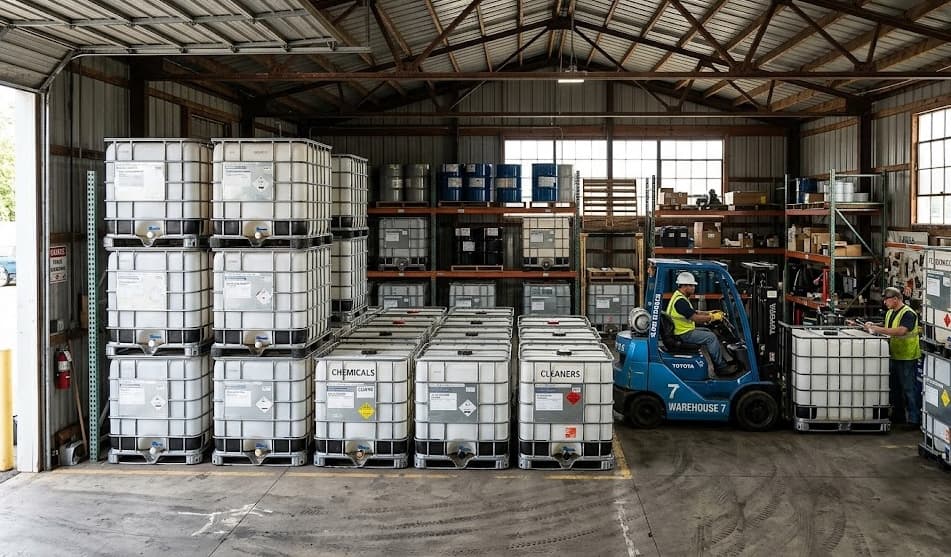
From chemicals aisle to pellet hopper.
The intake side of the recycling stream — totes come in still wearing their yellow hazard labels, get staged by prior-contents class, then move one at a time onto the wash line and from there into the granulator. The operator in the blue cab handles about forty units a shift, and reads every label before the tank clears the aisle.
The three output streams
Granulated in our 3-inch mill and sold to U.S. re-bottlers. Each batch ships with a chain-of-custody sheet.
Straightened when possible, scrapped when not. Cages are cut apart and sold by weight to Allegheny-area mills.
EPDM, silicone, and polypropylene are separated. Usable parts enter our accessories bin. The rest goes to a specialty elastomer reclaimer.
Why in-house granulation matters
Most recycling outfits ship used totes to a third-party shredder that loads them into a mixed-plastic stream. That's cheaper — but it means the HDPE gets blended with PET, PP, and the occasional slip of PVC, and the output pellet ends up being usable only for the lowest-grade applications (drainage pipe, pallet extrusion).
We granulate on site, clean, and keep the stream monotypic. That lets regional re-bottlers use our pellet as direct feedstock for new totes — closing the loop in a literal sense, not a marketing sense.
Got a cracked, burned, or mystery-residue tote?
Don't send it to a dumpster. Send it to us. We'll reclaim what we can and document what we can't. Even a single-unit recycling job gets a full ledger entry.
From cracked tank
to clean pellet.
The granulator isn't a single machine — it's a nine-step line that runs Tuesday, Wednesday, and Thursday in the west bay. Each stage is logged, every stream gets weighed before it leaves the building. Here's the walkthrough.
Intake & triage
Tote arrives, gets a reclaim tag with the ledger ID. We photograph exterior damage and record the last-known prior contents.
Cage cut-off
Oxy-acetylene cut at the four corner welds. The cage drops intact; pallet separates by bolts or a cold chisel.
Residue drain
Any remaining liquid pumps into the consolidation drum. Over 120 gallons and we stop — that tank goes to TSDF, not to us.
Caustic pre-wash
3% NaOH hot loop, 140°F, 20 minutes. Breaks down organic films that would foul the granulator knives.
Citric neutralizer
4% citric acid rinse brings pH back to 6.8–7.2 before any HDPE goes to the mill. Keeps the pellet buyer happy.
Shear & granulate
Bottle shears into 8–10″ strips, feeds the 3-inch granulator at ~180 lb/hr. Output is a 6–10 mm regrind flake.
Wash tank & dewater
Flake tumbles through a detergent wash and a centrifugal dryer. Moisture < 0.1% before it goes to the silo.
Silo & batch sample
Every 1,000 lb batch gets a 50-gram sample pulled and tagged for MFI and ash testing.
Shipment
Super-sacks on pallets, 2,000 lb each, trucked to re-bottlers with a chain-of-custody and the batch lot number.
What we accept.
Full-stream HDPE reclamation only works if the stream is actually HDPE. Below is the complete list of what the granulator is allowed to eat, and what gets diverted to a partner before it ever touches our bay.
- · 275 & 330-gallon IBC totes (HDPE bottle, any cage condition)
- · HDPE drums 15–55 gallon, clean or rinsable prior
- · HDPE pallet bins and food-grade tanks under 500 gal
- · Mauser, Schütz, Greif, SnyderIndustries, Hoover inners
- · Prior contents: food, beverage, cosmetics, glycol, fertilizer, detergent, non-listed agrichem, water-based coatings
- · Anything on EPA 40 CFR 261 P-, U-, or F- lists
- · Totes that held restricted-use pesticides (FIFRA)
- · PCB-era transformer oils, regardless of date
- · Petroleum products above 1 gallon of residue
- · Unknown residue with solvent odor or dark staining
- · Asbestos slurry containers (labeled or suspected)
- Resin family
- HDPE, monotype
- Density
- 0.948 – 0.954 g/cm³
- Melt flow index (190°C, 2.16 kg)
- 0.32 – 0.48 g/10min
- Ash content
- < 0.15%
- Moisture (shipped)
- < 0.08%
- Flake size
- 6 – 10 mm
- Color
- Light grey, natural blend
- Typical reuse ratio in new totes
- 20 – 35% by mass
Sample certificates attach to each 2,000-lb super-sack. Third-party assay on request for accounts buying over 20,000 lb/quarter.
The regs that
shape this work.
Recycling IBCs is one of the more over-regulated corners of industrial handling — for good reason. The 2019 PHMSA case in which a regional broker took a substantial fine for shipping uncertified totes is the cautionary tale we tell every new hire on day one. The rules we operate under, and what they mean for you:
Pennsylvania's container transfer and recordkeeping rule. Every tote we recycle gets a prior-contents declaration on file for seven years. DEP can audit any line item by ledger ID.
Clarified that HDPE reclamation from rinsed IBCs is a legitimate recycling activity, not waste processing, provided the monotype stream stays documented. Our in-house granulation keeps us inside that fence.
The federal packaging standard. We don't ship recycled pellet under packaging rules (it's a raw material, not packaging), but every tote we retest before recycling still carries a valid 2.5-year UN31A cycle mark.
The hazardous-waste listing. Any tote whose prior contents map to a P, U, or F code leaves our intake on a licensed-TSDF manifest, not our floor. We'd rather lose the buy-back than lose our RCRA standing.
Worked example —
a cidery flood.
In March 2025 a cidery in Westmoreland County had a wall of 22 filled totes fall during a forklift accident. Twelve bottles cracked, six cages bent beyond repair, four were salvageable. All 22 came to us as a single pickup because the cidery needed the dock cleared before the next truck.
Here's what that load turned into by Friday close.
- 4 totes returned after wash & retest
- → back in service
- 6 cages straightened & re-paired
- → fabrication stock
- 12 HDPE bottles granulated
- → 4,180 lb pellet
- 22 steel cages total (6 bent, 16 good)
- → 2,240 lb scrap
- 22 pallets (12 wood, 10 composite)
- → 10 reissued, 12 scrapped
- Gaskets, valves, plumbing sundries
- → 38 lb elastomer stream
- Residual cider liquor
- → municipal POTW under permit
- Landfill tonnage
- 0 lb
Total cycle: intake Tuesday, pellet out Friday. Cidery received a bound summary document for their insurance file on the following Monday.